Micro Design Sprints
We've recently started redefining the product discovery process and refining our understanding of our client's needs right from the beginning of our cooperation. As a service company, in 90% of cases, we have one question that we encounter at the very start "How much is this product going to cost us?"
We've recently started redefining the product discovery process and refining our understanding of our client's needs right from the beginning of our cooperation. As a service company, in 90% of cases, we have one question that we encounter at the very start "How much is this product going to cost us?"
Hence, we started developing what we call "micro product design sprints". Taking the best of both worlds product development by the book and fast, easy, and efficient product discoveries resulting in quick and detailed product scopes and estimations.
Our goal is to mitigate risk, scope the product, and provide a more accurate estimate than would be possible using a traditional model. Getting clients to make decisions faster and for us to be able to provide greater value to the client in less time. Hence close deals faster.
Overview
We currently have several variations depending on the client's exact needs, these are still evolving as you read this. We call it a "micro product design sprint". "Micro" because it's a highly condensed version of what we would consider a proper design sprint.
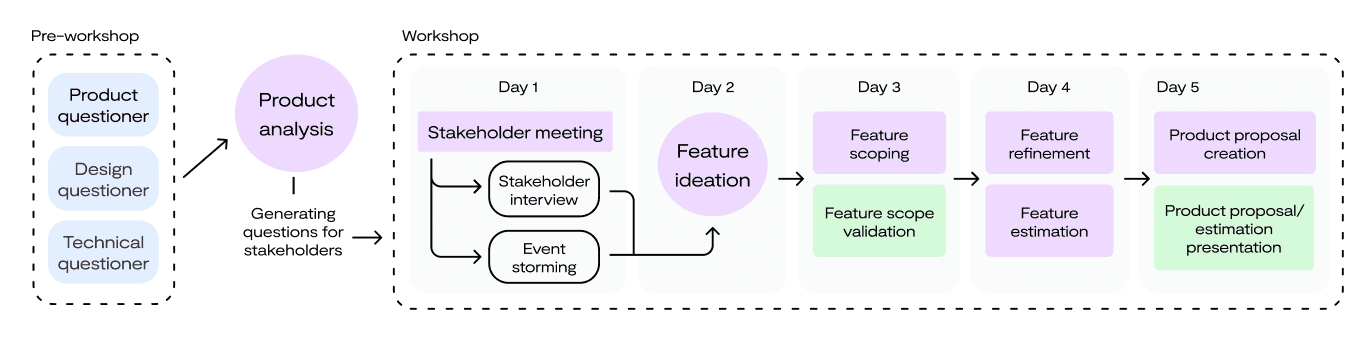
The "micro product design sprint" is a three-stage process:
Stage I: The client receives a product, technical, and design questionnaire about one week ahead of the kickoff. We start preparing.
Stage II: The actual grunt work – micro product design sprint – lasts from Monday to Friday.
Stage III: Education and risk relief. We let the client have a break and start the education about the process of digital product build and how to mitigate pitfalls.
The Diagram
The Team
- Product manager: Facilitates the process and is responsible for delivery.
- Solution architect: Works with product on feature scoping and is responsible for architecture/technology proposals.
- Product designer: Works together with product and solution architect on scoping features and provides a high-level design proposal (e.g., design system to be used).
The Process
Stage I: Product/Design/Technical Questionnaire
Day zero - Questionnaires
The stakeholders receive three questionnaires about a week in advance. Not too early, not too late, so there is enough time and still some pressure to complete all before the kickoff.
These questionnaires provide the product team with core information before starting the discovery process, allowing us to do a lot of work ahead of the first meeting.
Each of the questionnaires covers its specific area:
- Technical: questions regarding technical setup, previous builds, restrictions, and preferences.
- Design: defining client preferences and obtaining enough information to create a high-level user persona.
- Product: collecting client inputs on the core value of the product, customers, market, and its unique selling points.
Stage II: Micro Design Sprint
The micro design sprint lasts from Monday to Friday. The goal. Defining product functionalities, delivering an estimation and defining a build proposal. Unlike a proper design sprint, the time and effort are lessened, with far fewer meetings, with the stakeholders usually required to be present for about 6-8 hours in total.
Day 1: Stakeholder interview. This is a 2 x 1:30-hour meeting focusing on discovering the core value of the product idea and validating the data received in the questionnaires. We have defined a set of about 20 questions that we cover in the meetings and also have a discussion and event/brainstorming session with the client (the first hour and a half of the meeting is structured, and the second part is less structured).
Day 2: Feature ideation. Generating ideas on features and documenting them. We have developed a simple tool in the form of a spreadsheet where we start adding feature ideas and values that the feature generates. Nothing more complex than a spreadsheet, as everybody loves simplicity.
Day 3: Feature scoping. Grouping the features into feature sets and delving into them in greater detail. We have a 2-hour meeting with the client to get aligned. Still, we use a simple spreadsheet tool.
Day 4: Feature estimation. Estimating the features that should go into the build to provide a range.
Day 5: Product build proposal and estimation. We have the last meeting with the client and give a presentation on what we see as the core product and what would be the estimation behind it.
Stage III: Education
We talk about risks and educate the client about the process of building a digital product, addressing all uncertainties and any defined internal/external risks. We do this to establish a partnership where we're direct and upfront. Essentially, we help the client proactively make a decision, whichever it may be.
The Effort
On average, it takes 40-60 hours in total (team time) to complete one of our "micro product design sprints."
Sharing is Caring
If you are interested in learning more about the tools we have developed and the process we use during our "micro product design sprints," feel free to reach out at filip@lambdaworks.io.