Demystifying SMS Marketing - 10DLC, What Every Business Needs To Know About Large-Scale Messaging
Businesses often struggle with SMS marketing compliance, facing low delivery rates. The 10DLC system, created for high-volume messaging, has made compliance even more critical. By leveraging our experience with CSPs and TCR requirements, we’ve helped clients overcome challenges, achieve high delivery rates, and enhance their SMS strategies for more effective customer engagement.
Many businesses acknowledge the importance of effective customer engagement, whether by issuing notifications, performing 2FA, or providing real-time updates, for pursuing marketing goals. In a world where engagement is so important, many opt for using SMS, as statistics show that it has the highest open rate—up to 98%, far surpassing other methods like push notifications and email.
In the sphere of A2P (application-to-person) text messaging in North America, businesses have several options, including standard long codes, short codes, or the relatively new 10DLC (10-digit long codes). Regular long code numbers are cost-effective but not optimized for high-volume messaging - they often face carrier filtering issues. Shortcodes are expensive and require lengthy approval processes. The idea behind 10DLC was to provide a middle ground for businesses, as it offers several good things from both worlds.
Key Actors in the 10DLC Ecosystem
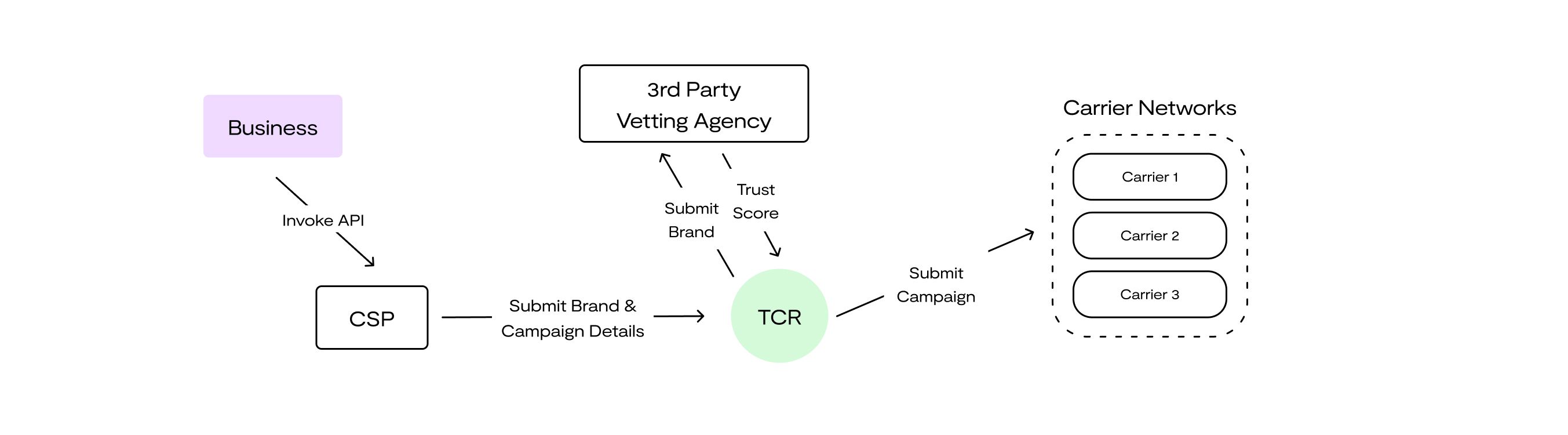
The Campaign Registry (TCR) is the main governing body for the A2P 10DLC. This body verifies the business's legitimacy and the purpose of its messaging so that the messages can be delivered on a large scale and with appropriate throughput. However, the 10DLC application can’t just be submitted to the TCR directly, but through the Campaign Service Provider (CSP). Some of the most prominent CSPs include Twilio, Vonage, Sinch, Bandwidth, etc. Hence, for most businesses, the process starts by interacting with one of the CSPs.
Navigating the Registration Process
It's important to note that 10DLC is not tied to a single phone number. Once 10DLC registration is completed, numbers can be added or replaced. This flexibility is due to the distinct concepts of Brands and Campaigns within the 10DLC. The first step of the 10DLC approval process is Brand registration, which is just a 10DLC representation of common information about the business. Different types of Brands exist, and they may be categorized differently by each CSP. Typically, these include Sole Proprietor brands for businesses without a Tax ID, Low-Volume brands for those with a Tax ID but limited messaging needs, and Standard brands for the ones requiring high messaging throughput.
Once CSP verifies the Brand the process of 10DLC registration can continue. The next steps depend on the type of the Brand. If the brand is of type Standard, it needs to be vetted. The vetting is done by third-party agencies approved by the TCR. The vetting results in the trust score assigned to the Brand. Trust score has a direct impact on messaging throughput. After receiving the trust score, there is one last step in this process - Campaign registration.
The campaign registration process involves outlining the messaging flow, detailing how opt-ins and opt-outs are handled, and providing several sample messages. In the case of standard brands, it’s possible to choose the type of campaign, which will further impact the throughput of the whole 10DLC application.
The registration process takes time and depends on both CSP and TCR. Most of the time is spent waiting for the campaign to be approved. Once it is approved numbers can be linked. All CSPs charge for Brand registration (based on the brand type) and brand vetting (if vetting is needed). Alongside the regular monthly price for each active campaign, several CSPs introduced one-time fees for campaign vetting.
Since its introduction, the 10DLC system has experienced a rocky rollout. Deadlines were often pushed back, and the process underwent several changes, sometimes with new restrictions being implemented unexpectedly. But one thing is certain, regular long code messages without 10DLC are no longer being delivered.
Mastering 10DLC: Insights from our experience
When we talk about API integrations for 10DLC registration and general process, it depends on the choice of CSP provider. Some of the platforms are overly complicated, and certain ones need more than 20 API calls to get your campaign up and running. This usually provides significant obstacles for regular users. There are also a lot of discrepancies between CSPs regarding the constraints and validity of the data, for both Brand and Campaign registration, as well as the duration of approval and vetting, ranging from a couple of days to a couple of weeks.
Through extensive experience with 10DLC and adapting to industry changes, we have achieved significant success in helping customers select the right variant for their needs and solving challenges in the registration process. Once the campaign is approved, everything runs seamlessly - an outcome that truly benefits customers. As long as the general 10DLC messaging guidelines are followed, delivery rates are high. While navigating the registration process has complexities, the effort pays off, as registered 10DLC is a cost-effective solution for mass A2P messaging.
References
- The Campaign Registry Official Website
https://www.campaignregistry.com - 37 Fascinating SMS Marketing Statistics and Trends for 2023
https://techreport.com/statistics/finance-marketing/sms-marketing-statistics/